
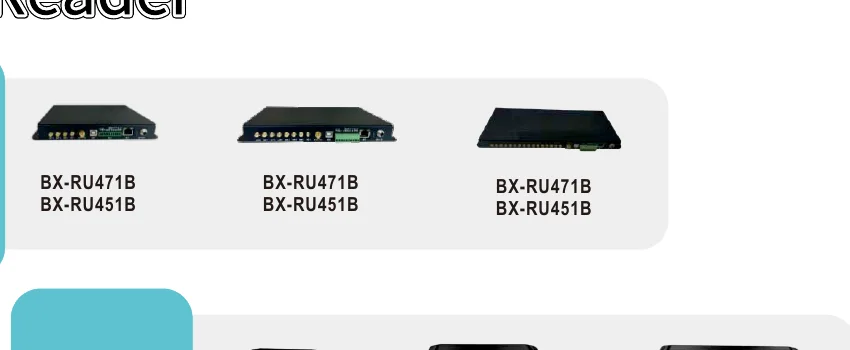
Description
Application-engineered RFID
Select the reader platform around the read zone, antenna architecture, interface and system-integration requirements.
A fixed UHF reader family for integrating reliable tag capture into gates, workstations and automated processes.
Where it fits
Applications
Start with the operating workflow. The product configuration is then reviewed around the object, users, read points and surrounding environment.
Why this platform
Core capabilities
Each project is shaped by the required performance, mechanical format and integration path—not by a one-size-fits-all specification.
Platform choice
The catalog family includes Impinj E710, E510 and R2000 module platforms, depending on model.
Read-zone engineering
Reader, antennas, cabling, power and mounting can be considered as a complete capture point.
Integration-oriented
Interface and enclosure requirements are reviewed around the host system and installation environment.
Family-level selection
Multiple BX-RU models allow the hardware format to be matched to the deployment scenario.
Source-verified data
Technical overview
Values below come from the supplied BXAIOT catalogs. Model-dependent items must be confirmed against the selected configuration.
| Catalog model family | BX-RU471B, BX-RU451B, BX-RU461B, BX-RU461C, BX-RU461D and BX-RU410B |
|---|---|
| Module platforms shown | Impinj E710 / E510 and Impinj R2000, depending on model |
| Frequency region | Pending technical review for the selected model |
| RF ports / output power | Pending technical review for the selected model |
| Interfaces / enclosure / environment | Pending technical review for the selected model |
Built to requirement
Customization scope
Share the application and target configuration. BXAIOT will review the technical fit before the build is confirmed.
From requirement to build
Project path
A clear validation path reduces ambiguity before production and keeps the product aligned with its real operating environment.
Define
Application, object, users, environment, read points and data flow.
Configure
Technology, chip, antenna, mechanics, materials and integration options.
Validate
Confirm source parameters and evaluate samples in the intended workflow.
Produce
Approve the final specification, artwork, data rules and quality checkpoints.
Build the complete workflow
Related products & solutions
Connect this product to the readers, tags and application layer needed for a complete deployment.
Before you specify
Frequently asked questions
These answers describe the current catalog scope without replacing project-level technical confirmation.
Which fixed reader model should I choose?
Define the number and shape of read zones, antenna count, tag population, regional frequency, host interface, mounting and environment. We will narrow the model family from those requirements.
Does the reader include antennas?
The final system scope should confirm the reader, antennas, RF cables, power, mounting and any edge or host software separately.
Can it integrate with an existing system?
Integration can be reviewed against the required interface, data flow, event logic and host software environment.
Start with your application
Tell us what the product needs to do.
Send the target workflow, environment, dimensions, reader or platform details, and expected data flow. Our team will review the configuration with you.
Technical values are derived from the supplied catalog and remain subject to project confirmation. No certification, fixed lead time, MOQ or universal performance claim is implied.